


Airport Chairs and More: How to Choose the Right Airport Furniture for High-Traffic Areas?
Airport Chairs for high-traffic public areas should combine stable supporting structures, suitable seat materials, practical cleaning access, flexible configurations, and manageable maintenance requirements. Buyers should evaluate long-term operating needs rather than appearance alone.
How Can Buyers Determine the Required Seating Structure?
The first step is to understand the actual usage conditions.
An airport terminal may experience different passenger volumes throughout the day, with some areas facing concentrated traffic during peak departure periods.
Buyers should establish:
Expected passenger turnover.
Average waiting duration.
Peak seating demand.
Number of seats required.
Available installation space.
Cleaning frequency.
Expected maintenance resources.
These details help determine whether a connected beam chair, individual chair, or lounge seating arrangement is more appropriate.
Why Does the Beam Structure Matter?
In connected airport seating, the supporting beam links several seat units into one structure.
Its dimensions, material, connection points, and supporting legs influence the overall seating arrangement.
Buyers should check:
Beam Material
Confirm whether the structure uses steel, aluminum, or another specified material.
Beam Profile
Different designs, including triangular and hexagonal beams, have different structural configurations.
Connection Points
The connection between each seat, beam, and supporting leg should be inspected.
Assembly Accuracy
The complete seating row should maintain proper alignment when installed.
For projects involving long connected rows, the supporting structure should be evaluated according to the complete configuration rather than judging a single seat in isolation.
Which Seat Materials Are Suitable for High-Traffic Airport Chairs?
The seat surface affects comfort, cleaning, and maintenance.
Different materials have different advantages.
PU Seating
PU seats provide a shaped and cushioned contact surface.
They are used in airport chairs where a balance between passenger comfort and routine surface cleaning is required.
The material hardness, surface quality, and internal supporting structure should be checked during sample approval.
Perforated Metal Seating
Perforated metal seats provide a rigid surface and a different appearance from cushioned PU seating.
Their design should be evaluated for edge finishing, cleaning requirements, and passenger comfort.
Molded Plastic Seating
Molded plastic seating provides another option for public benches and waiting areas.
Buyers should evaluate material specifications, panel thickness, structural support, and resistance to the expected use conditions.
The best material depends on the project environment and maintenance plan.
How Many Seats Should Be Installed in Each Row?
Seat quantity influences both the total seating capacity and the layout.
OUHE airport chair models include one-to-five-seat configurations.
For example:
One-seat units may suit smaller waiting spaces.
Two-seat units can fit compact waiting areas.
Three-seat configurations provide a common arrangement for public waiting zones.
Four- and five-seat units can accommodate larger continuous seating rows.
However, the maximum number of seats should not automatically be selected for every location.
Buyers must leave suitable space for aisles, wheelchairs, luggage, and maintenance access.
What Should Be Checked for Cleaning and Maintenance?
High-traffic airport chairs are exposed to frequent contact and regular cleaning.
Maintenance convenience should therefore be included in the original product specification.
Important details include:
Whether the seat surface can be wiped easily.
Whether the frame finish is compatible with the cleaning routine.
Whether dirt can collect around exposed joints.
Whether the chair has accessible connection components.
Whether damaged components can be replaced.
Whether spare parts can be supplied for repeat orders.
Cleaning products should be checked for compatibility with the PU surface and metal finish.
A maintenance plan should also include periodic inspection of connections, supporting beams, and floor fixings where applicable.
How Can Buyers Compare Initial Price With Long-Term Cost?
The lowest quotation may not always represent the best purchasing decision.
Airport seating should be evaluated through its expected ownership cost.
A practical assessment includes:
Initial product price.
Transportation and installation costs.
Routine cleaning requirements.
Expected maintenance work.
Availability of replacement components.
Repair and replacement arrangements.
Consistency across future orders.
A product with suitable construction and accessible replacement components may be more practical than a cheaper model that requires complete replacement after localized damage.
Which OUHE Airport Chair Models Can Be Considered?
Our airport chair range includes different supporting structures and seating materials.
| Model | Seat Construction | Supporting Structure | Configuration |
|---|---|---|---|
| P2108 | PU within steel frame | Metal triangular beam | 1–5 seats |
| P2302 | PU within steel frame | Aluminum arms and legs, metal triangular beam | 1–5 seats |
| P2105 | PU with steel inner frame | Aluminum arms and legs, metal hexagonal beam | 1–5 seats |
These models provide different product configurations for commercial waiting environments.
The selection should be based on the project drawing, material requirements, installation conditions, and approved product specifications.
How Does Our Factory Support High-Volume Airport Seating Projects?
Our manufacturing base covers more than 50,000 square meters and includes seven specialized factories.
The production system integrates metal stamping, robotic welding, surface spraying, PU manufacturing, Sofa production, carton manufacturing, and packaging.
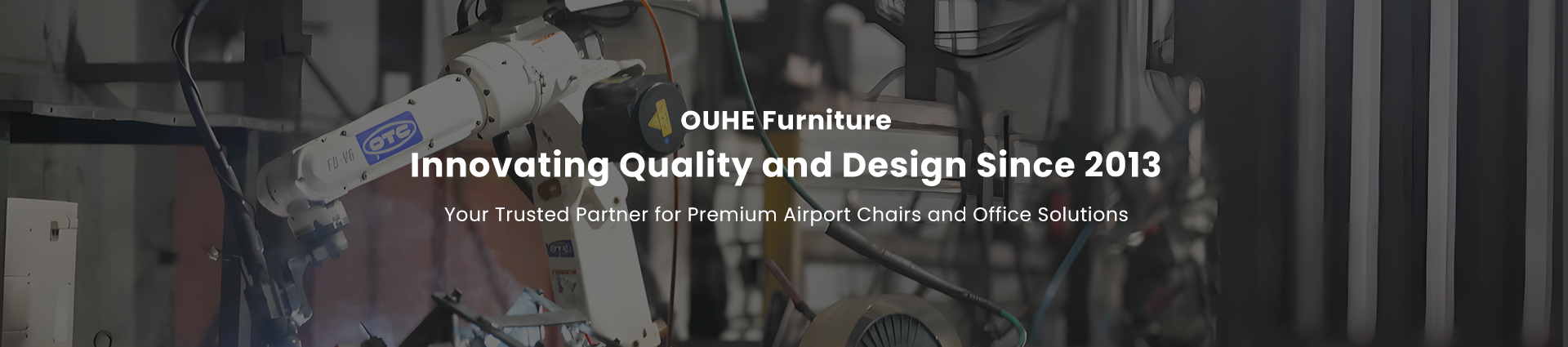
We use 40 sets of Japan OTC automatic robotic welding equipment for Waiting Chair production.
This helps maintain repeatable welding processes when producing large quantities of connected seating units.
Our PU production equipment also supports different seat sizes, colors, and hardness levels.
For project buyers, these integrated capabilities allow our team to coordinate product specifications and manufacturing requirements across different airport seating configurations.
Select Airport Chairs Based on Real Project Conditions
High-traffic seating should be selected according to passenger volume, structure, material, cleaning routines, and long-term maintenance requirements.
Discuss Your High-Traffic Airport Seating Project
Share your floor plan, required seat quantities, preferred materials, beam configuration, and technical specifications to discuss customized airport chair manufacturing and bulk supply.
Previous:
Next: What Are The Characteristics Of The Furniture Used in Airports?