


How Do We Turn Raw Materials into Waiting Chairs, Sofas, and Classroom Desks and Chairs Built for Heavy Use?
For airports, schools, hospitals, and public buildings, furniture is not just decoration. It must support thousands of users every day, stay comfortable over years, and still look presentable under strong cleaning routines.
Behind these requirements lies a key question for buyers:
How does OUHE transform basic steel, PU, wood, foam, and fabric into durable Waiting Chairs, Sofas, and Classroom Desks And Chairs?
The answer is our vertically integrated production system. OUHE operates more than 50,000 m² of plant area, combining seven specialized factories: metal stamping, robot welding, hardware spraying, PU, sofa, carton, and packaging & shipment facilities.
From the first cut of steel to the final packed carton, every step happens inside our own manufacturing chain.
The following sections walk through this journey “from raw materials to finished products,” explaining how each process protects your project’s long-term performance.
1. Raw Material Stage: Choosing the Right Foundations
Before any frame is welded or any sofa cushion is stitched, OUHE engineers work on material selection. Because we focus on three main series—Waiting Chair, Sofa, Classroom Desks and Chairs—we define material standards for each one.
At a high level, the raw material structure looks like this:
| Product Series | Structural Core | Comfort Layer | Visible Surfaces |
|---|---|---|---|
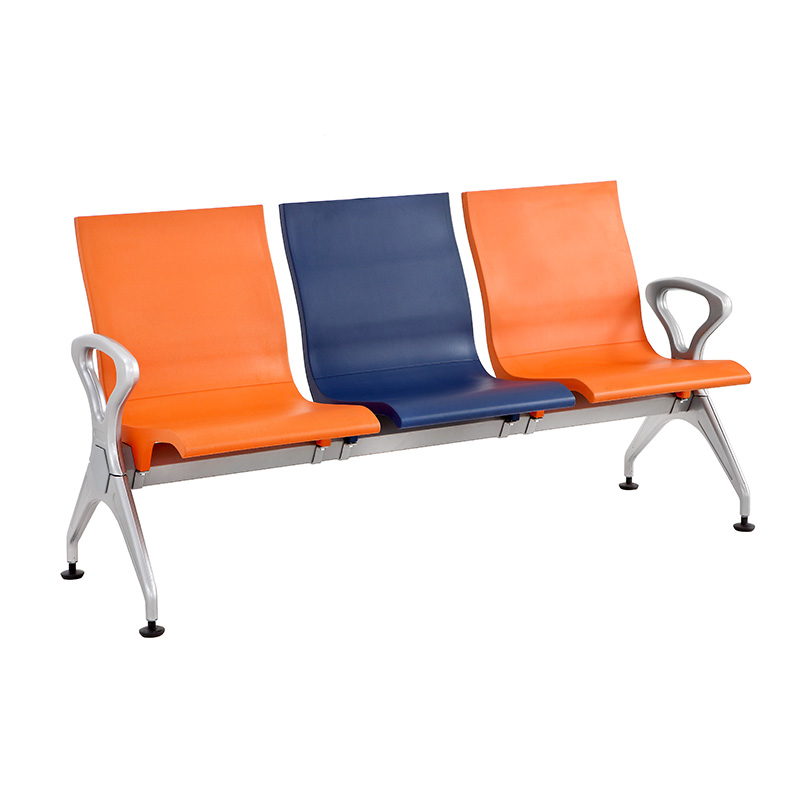
| Waiting Chair | Steel beams, steel or aluminum legs | PU shells or padded surfaces | Powder-coated metal, colored PU |
| Sofa | Wood and metal inner frame | High-resilience foam, webbing/springs | Fabric or synthetic leather upholstery |
| Classroom Desks and Chairs | Steel frames, desk supports | Optional seat pads, plastic parts | Desk boards, PP shells, coated steel |
Metals for Strength
Cold-rolled steel is selected for beams, legs, and support brackets. For some waiting chair designs, aluminum is used for armrests or legs to reduce weight and add a sleek, modern appearance. Metals are specified by thickness and grade so they can be stamped, welded, and coated without internal weakness.
PU for Public Seating
In the PU factory, raw polyurethane systems are prepared for foaming. The formulation is tuned to deliver:
Sufficient hardness to resist deformation in high-traffic waiting zones
Enough elasticity to remain comfortable during long waiting times
Consistent color and surface quality for large project batches
OUHE invested heavily in polyurethane foaming machines to produce PU Airport Chairs in different sizes, hardness levels, and colors, all with accurate dosing and stable performance.
Foam, Fabric, and Boards for Sofas and Classroom Furniture
For sofas, rolls of upholstery fabric, synthetic leather, foam blocks, webbing, and internal wooden frames form the soft seating platform.
Classroom furniture uses desk boards, PP or similar plastic components, and protective edge trims designed for student use and easy cleaning.
With the material stage complete, the journey continues into heavy processing.
2. Waiting Chairs: From Steel and PU to Finished Public Seating
The waiting chair series is one of OUHE’s signature product lines. Every day, thousands of units leave our plant to serve transportation hubs and public spaces around the world. To support this scale, we rely on a fully automated, high-capacity production flow.
2.1 Metal Stamping and Backrest Punching
Steel sheets and tubes first enter the metal stamping factory. Here, presses cut and form legs, beams, brackets, and perforated backrests.
OUHE operates four high-speed backrest punching machines capable of reaching 320 strokes per minute.
This capacity allows us to produce large volumes of identical components, which is critical for big projects where hundreds or thousands of seats must match perfectly.
2.2 Robot Welding: Building the Frame
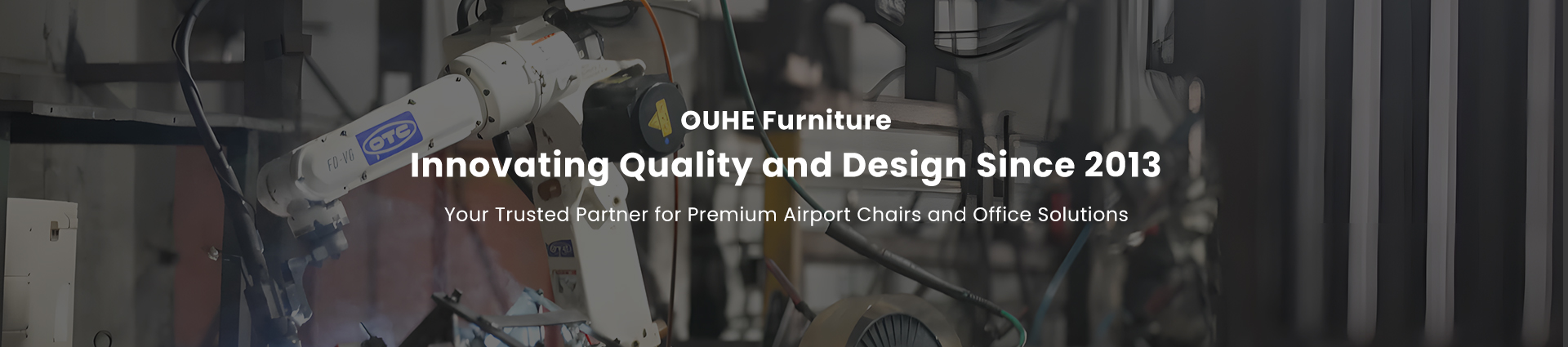
Stamped components then move to the robot welding factory. OUHE uses about 40 sets of Japan OTC automatic robot arms, all optimized for waiting chair structures.
The benefits of robot welding for waiting chairs are significant:
Welds are consistent from chair to chair, so load capacity is predictable.
Robots can run 24 hours a day, supporting daily capacity of more than 5,000 sets for regular waiting chair models.
Beautiful, uniform weld seams enhance aesthetics for modern terminals and lobbies.
Technicians inspect key joints and add manual reinforcement where required, blending efficiency with human judgment.
2.3 PU Foaming and Shell Production
While frames are being welded, the PU factory is producing shells, arm elements, and other molded parts. The latest rotary-valve perfusion technology ensures:
Accurate mix ratios and injection volumes
Stable foaming reactions without clogging
Flexibility to create different sizes and hardness levels for the same project line
For some models, the PU is foamed around an internal steel frame, combining structural strength with a seamless surface.
2.4 Spraying and Surface Finish
Frames and metal parts then enter the hardware spraying factory, which includes a 1,500-meter-long production line linking directly to the packaging area.
In this continuous line, components pass through cleaning, drying, powder application, and curing. After an equipment upgrade of more than 2 million yuan in 2022, the multi-functional spraying rooms and environmental systems now operate at a leading standard in the industry.
For waiting chairs, the coating must resist not only corrosion but also abrasion from luggage, shoes, and cleaning tools.
2.5 Assembly, Testing, and Packing
Finally, beams, legs, PU shells, and accessories are assembled into finished rows. Each set is checked for:
Frame stability
Surface quality
Alignment and levelness when placed on the floor
Only after passing inspection do the chairs continue to customized cartons produced in our own carton factory. The result is waiting chair seating that can withstand crowded terminals, public waiting rooms, and clinics for years.
3. Sofas: Integrated Design, Frame Building, and Upholstery
Sofas require a different type of craftsmanship. OUHE’s sofa factory handles the complete process from product design through delivery, allowing us to balance comfort, appearance, and cost.
3.1 Frame and Support Construction
The sofa journey begins with internal frames made of wood and metal. The frame defines the sofa’s silhouette and strength. Cross braces and support rails are fixed to withstand long-term loading in offices, reception areas, and living spaces.
3.2 Foam and Webbing Installation
High-resilience foam is cut and layered according to the design. Elastic webbing or spring units are fixed into the seat base. This combination determines how the sofa feels when someone sits down:
Softer foams and deep layers create lounge-like comfort.
Firmer constructions provide professional support for office or lobby settings.
3.3 Upholstery Cutting and Sewing
In the upholstery section, fabric or synthetic leather is cut using templates matched to each model. Sewing teams assemble covers with reinforced seams and shaping stitches, ensuring they fit smoothly over corners and curves without excessive tension.
3.4 Final Sofa Assembly and Inspection
Cushions, backrests, and arm elements are attached to the frame. At this stage, OUHE’s quality team checks:
Seat height and depth
Backrest angle
Overall comfort when sitting for a longer period
Visual details such as seam alignment and surface smoothness
Because all design, mold development, and production processes for office sofas are handled in-house, OUHE can rapidly roll out new models and control cost for project buyers.
4. Classroom Desks and Chairs: Durable Furniture for Learning Spaces
Classroom furniture faces a unique challenge: it must be cost-effective for large-scale procurement yet robust enough to withstand years of everyday student use.
4.1 Steel Frames and Desk Structures
The manufacturing route for classroom desks and chairs parallels the waiting chair process in several respects: steel tubes are stamped and bent into frames, then welded using automated equipment where appropriate. Stability and dimension accuracy are critical, because hundreds of desks must sit level in the same room.
4.2 Desk Boards, Storage, and Seat Elements
Desk tops and chair shells are then assembled onto the steel frames. Depending on the model, components may include:
Writing surfaces with rounded edges
Under-desk storage trays or shelves
Ergonomic seat bases designed for posture support
The goal is not only durability but safety and comfort for students spending many hours per day at the desk.
4.3 Classroom Furniture at a Glance
| Stage | Key Operations | Result in Classroom Use |
|---|---|---|
| Metal processing | Stamping, bending, welding | Stable frames that do not wobble |
| Surface finishing | Powder coating | Frames resistant to scratches and humidity |
| Component integration | Board fixing, shell mounting, assembly | Desks and chairs that stay aligned and square |
| Final inspection | Load tests, visual checks | Safe, long-lasting classroom environments |
With these steps, OUHE delivers classroom furniture that supports serious learning environments, from primary schools to training centers.
5. The Role of the Spraying, PU, and Carton Factories in the Whole Chain
One of OUHE’s strongest advantages is that critical “supporting” processes are not outsourced; they are embedded inside the company.
The spraying factory ensures consistent coating quality and environmental compliance across all three product lines. The long conveyor line connects directly to packaging, reducing handling damage.
The PU factory gives us the ability to design and produce high-grade PU components for waiting chairs in different hardness levels and colors, enriching the series and enabling customization.
The carton and packaging factories allow OUHE to design cartons that fit waiting chairs, sofas, and classroom sets precisely, reducing shipping damage and optimizing loading for export to more than 60 countries and regions.
This closed loop from raw material to packed product keeps lead times under control and provides buyers with a clear traceability path.
6. Why This Manufacturing Flow Matters for Your Project
Understanding the production journey explains why OUHE’s furniture performs reliably in real-world projects.
Consistency across large orders
Robot welding, high-speed punching, and controlled PU foaming allow thousands of identical waiting chairs or classroom sets to be produced with the same quality level.Stronger cost control and delivery reliability
Because stamping, welding, spraying, PU, upholstery, and packaging are all in-house, OUHE can schedule and balance capacity across product lines without depending on external suppliers.Higher design and customization flexibility
In-house mold development, PU production, and sofa design teams make it possible to adapt seating solutions to different airports, schools, and commercial interiors, while staying within realistic budgets.Compliance and long-term partnership
OUHE has obtained ISO9001 quality management and ISO14001 environmental certificates, providing assurance that processes are documented, controlled, and continuously improved.
Conclusion
The transformation from raw steel, PU, fabric, wood, and boards into finished Waiting Chairs, Sofas, and Classroom Desks and Chairs is more than a series of technical steps. It is a carefully designed system that connects:
Material selection
Precision metal processing
PU foaming and upholstery craftsmanship
Automated spraying and environmental control
Final assembly, inspection, and protective packaging
By integrating all of these stages within one 50,000 m² facility, OUHE builds furniture that is not only visually appealing but also engineered for high-traffic, long-life applications.
For project buyers seeking reliable seating and classroom solutions, this complete “from raw materials to finished product” manufacturing chain is the real reason OUHE furniture continues to perform in airports, schools, and public spaces worldwide.