


How to Make Airport Waiting Chairs?
Airport Waiting Chairs are not ordinary seating. They must handle constant public use, high passenger turnover, frequent cleaning, and strict safety expectations, while still looking consistent across large terminal areas. Making Airport Waiting Chairs requires a controlled manufacturing chain that combines structural engineering, automated welding, precision punching, surface finishing, and repeatable assembly. When any step is weak, the chair can wobble, squeak, corrode, or show cosmetic defects quickly, which increases replacement cost for airports and contractors.
This article explains how airport waiting chairs are made, focusing on the full process from material selection and frame production to coating, foam forming, quality inspection, and packaging. It also explains why OUHE’s manufacturing setup supports stable quality and high-volume delivery for airport projects. You can view OUHE’s airport seating solutions in our airport chair range.
Defining Requirements Before Manufacturing Begins
The manufacturing process starts with engineering requirements, not with fabrication. Airport waiting chairs must meet loading expectations for continuous public use, resist corrosion and surface wear, and maintain stability even on uneven flooring. They also need maintenance-friendly structures, because airports require fast part replacement and easy cleaning during daily operations.
Before production, manufacturers typically confirm:
Seat module size, seat count per beam, and spacing based on terminal layout
Expected weight load and structural safety margin for public seating
Material strategy for metal parts, armrests, seat shells, and fasteners
Surface finish requirements for scratch resistance and long-term appearance
Packaging and shipping method to reduce damage during long-distance transport
Once these inputs are fixed, the product can be standardized for repeatable mass production.
Material Selection and Component Planning
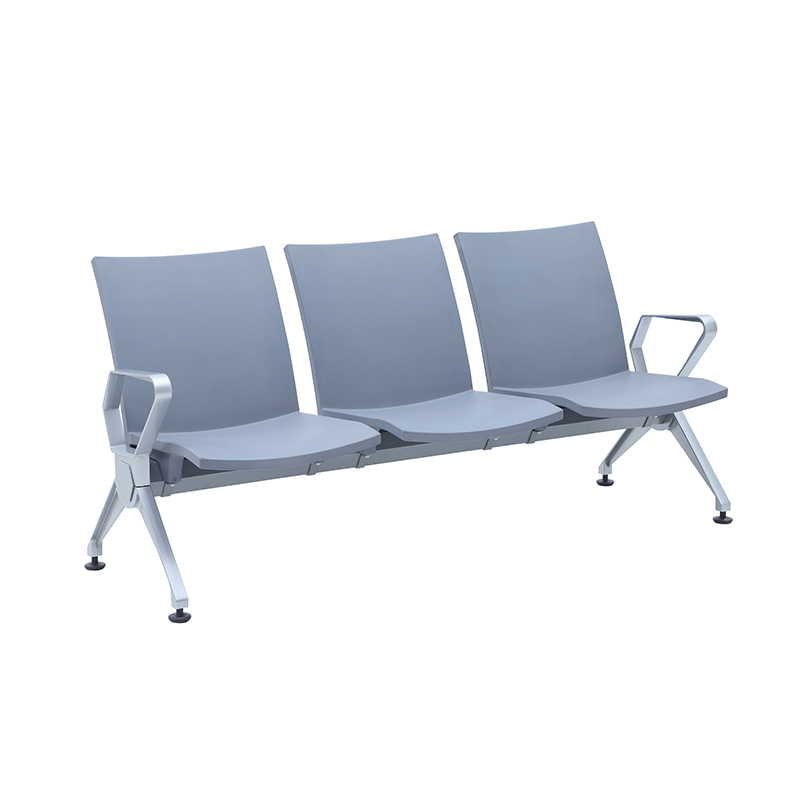
Most airport waiting chairs use a metal beam structure combined with seat and back components that may include metal shells, PU molded parts, or composite assemblies. Material choice is tied directly to corrosion resistance, structural strength, and how well the chair maintains its appearance under constant cleaning.
A typical performance-oriented approach includes:
Steel or stainless steel structural parts for strength and long service life
Engineered PU seating for comfort and durability in high-traffic areas
Standardized fasteners and modular parts to simplify assembly and maintenance
Reinforced joints in high-stress areas such as beam supports and leg connections
OUHE manufactures both metal and PU series Airport Chairs, which allows the same production system to cover different project budgets and comfort requirements while maintaining stable structural design.
Metal Stamping and Precision Punching
Airport chairs require high dimensional consistency so that seat modules align correctly across multi-seat beams. This is why stamping and precision punching are used for key sheet-metal parts, brackets, and connection components. Consistent punching ensures bolt holes align during assembly, reduces manual correction, and improves final stability.
In OUHE’s production system, high-speed punching capacity supports mass production efficiency. Punching speed and repeatability matter because airport seating projects often require thousands of seats with identical alignment and appearance.
Robot Welding for Structural Consistency
Welding quality is a major factor in whether an airport chair feels solid or unstable. Manual welding can vary by worker skill and fatigue, which affects bead consistency and joint strength. Automated robot welding improves repeatability and makes quality easier to control across large batches.
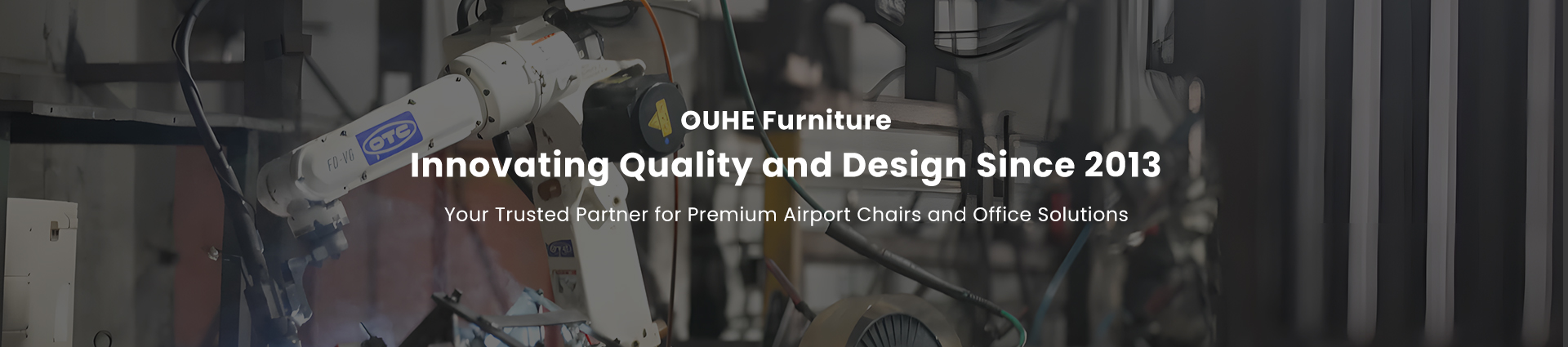
OUHE uses automatic robot welding for waiting chair series products, helping maintain consistent joint quality and stable appearance compared with purely manual welding. Continuous robot operation also improves throughput for project delivery schedules.
Surface Preparation and Coating for Wear Resistance
Airports demand finishes that resist scratching, discoloration, and corrosion. The surface treatment stage typically includes cleaning, pretreatment, and then coating, with strict control over thickness and adhesion. If coating is uneven, the chair may show color differences, premature chipping, or visible defects under bright terminal lighting.
OUHE operates a complete spraying plant with environmental protection equipment and process control. A stable coating workflow is important because airport chair frames are high-visibility items that must maintain a uniform finish across the terminal.
PU Foaming and Molded Seating Production
For PU airport chairs, comfort and durability depend on the foaming process and mold accuracy. A controlled PU system provides consistent density, stable rebound, and reliable shape across batches. It also supports customization in size, color, and hardness for different airport design requirements.
OUHE invests in polyurethane foaming machines and uses a PU production system that supports a wide range of PU seating specifications. This allows projects to select seating comfort levels while keeping the structure standardized for mass production.
Assembly Line Production and Modular Build
Once parts are produced, assembly must be structured to reduce errors and speed up delivery. Airport chairs are typically modular, meaning seat units, armrests, legs, and beams are assembled in a controlled sequence. Good assembly design reduces rework and makes chair maintenance easier after installation.
A reliable assembly workflow focuses on:
Fixed torque standards for fasteners to prevent loosening
Alignment checks for beam modules and seat spacing
Seat and back fixation stability to prevent movement and noise
Pre-install verification to reduce on-site adjustment
OUHE’s production setup includes multiple factories and supporting departments, enabling a more complete supply chain from metal production to packaging and shipment.
Quality Inspection and Process Control
Public seating projects require stable quality across large orders. This is achieved through process-based quality control rather than end-only inspection. Manufacturing teams typically inspect parts after each critical stage, such as punching, welding, coating, and final assembly.
Quality control for airport waiting chairs often includes:
Dimensional checks for hole alignment and beam straightness
Weld inspection for consistency and joint integrity
Coating inspection for thickness, adhesion, and surface uniformity
Assembly checks for stability, wobble, and noise during movement
Packaging checks to prevent transport damage
OUHE holds ISO9001 certification and operates structured production management, supporting stable quality output across repeated project deliveries.
Packaging, Shipping, and Delivery Planning
Airport chair projects often ship internationally and may require container optimization to reduce freight cost. Packaging must protect coated surfaces and avoid scratch damage. It must also support fast unloading and installation by contractors.
Effective packaging typically includes:
Protective wrapping on visible metal surfaces
Structured carton or crate design that prevents movement in transit
Clear labeling for installation sequence and seat module grouping
Shipment planning aligned with terminal construction schedules
OUHE has dedicated packaging and shipping facilities, supporting better delivery control and order consolidation for large projects.
Production Capability That Supports Large Airport Projects
For airport seating, manufacturing scale affects delivery stability. OUHE operates a production base of over 50,000 square meters with multiple supporting factories, including metal stamping, robot welding, spraying, PU production, Sofa production, and packaging. The company uses modern production equipment including robot systems and high-speed punching machines, and can support continuous production scheduling.
This integrated manufacturing structure supports:
Faster lead times for large batch orders
More stable quality across long production runs
Better control of finish consistency across multi-container shipments
OEM capability for customized designs, colors, and configurations
OUHE airport seating products are exported to many countries and regions, supporting international project delivery.
Conclusion
Making airport waiting chairs requires a complete system, including requirement engineering, precision punching, robot welding, controlled coating, modular assembly, and structured quality inspection. Each step affects stability, durability, appearance consistency, and delivery speed. When the manufacturing chain is integrated and automated, airport seating can maintain consistent quality across thousands of units while meeting project timelines.
If you need airport waiting chair solutions designed for large public spaces and produced with stable mass production capability, explore OUHE’s airport chair range.