


What Are the Characteristics of Airport Chair Materials?
Airport waiting areas demand seating materials that can handle continuous traffic, frequent cleaning, rolling luggage impact, and long-hour sitting comfort. The material choice is not only about appearance. It directly affects durability, maintenance cost, corrosion resistance, and how well the chair keeps its shape after years of use.
OUHE supplies commercial-grade seating through the Waiting Chair range, offering multiple material configurations so projects can match different budgets, environments, and design requirements while maintaining stable production quality.
Why material selection matters in airport Waiting Chairs
In public transportation hubs, chairs are exposed to a unique combination of stress factors.
High contact frequency
Armrests and seat edges experience constant abrasion from clothing, bags, and repeated sitting cycles, so surface hardness and scratch tolerance become critical.Aggressive cleaning routines
Airports often use frequent wipe-downs and disinfectants. Materials must resist staining, corrosion, and finish dulling from repeated chemical contact.Mixed climate conditions
Coastal terminals, humid regions, and air-conditioned interiors create condensation cycles that accelerate corrosion if metal selection and coating are not appropriate.Comfort under long dwell times
For passengers waiting 30 to 120 minutes or longer, seat feel, thermal comfort, and pressure distribution are closely tied to the seat material and internal structure.
Core Airport Chair material options used in OUHE waiting chairs
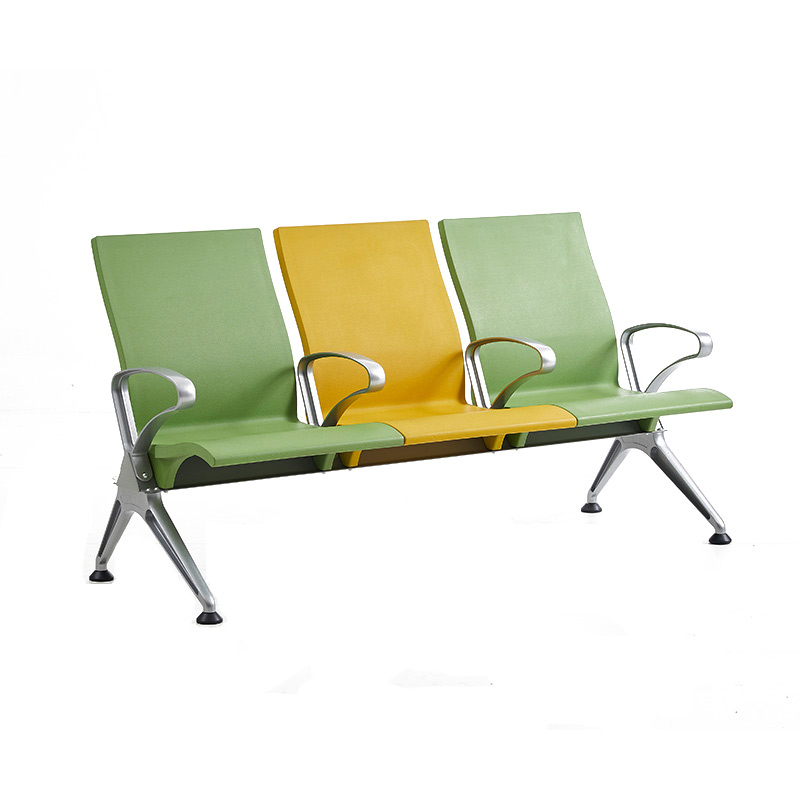
OUHE configurations commonly include PU seating structures, stainless steel seating structures, and painted steel seating structures. Each has distinct characteristics suited to different terminal zones.
1. PU within steel frame with aluminum arms and legs and metal triangle beam
This structure combines a reinforced internal steel frame with PU seating surfaces, supported by aluminum arms and legs and a triangle beam for stability.
Seating comfort and shape retention
PU provides a more resilient sit than flat metal seating. With a steel frame inside, it maintains geometry under repeated loading, helping reduce seat sagging and deformation in high-traffic areas.Surface practicality for public spaces
PU surfaces are typically easier to wipe clean than textured fabric. For terminals requiring frequent sanitation, PU can reduce cleaning time while keeping the seating area visually consistent.Structural rigidity from the triangle beam
Triangle beam geometry is widely used in public seating because it increases stability and helps limit torsional flex across multi-seat units, especially when passengers sit on only one end.Lightweight corrosion-resistant support
Aluminum arms and legs reduce overall weight and provide strong corrosion resistance, which is useful for humid climates and coastal airports where metal oxidation risk is higher.
2. PU within steel frame with PU-covered aluminum arms and aluminum legs and metal hexagonal beam
This configuration upgrades touch points and enhances beam strength characteristics.
Improved touch comfort on arm areas
PU-covered arm sections feel warmer and less harsh than bare metal in cold air-conditioned halls. The covered surface can also reduce visible micro-scratches from watches, rings, and luggage contact.Strong base support with aluminum legs
Aluminum legs offer a balance of strength and corrosion resistance, supporting long-term use where floor cleaning water and humidity are common.Hexagonal beam advantages in long rows
A hexagonal beam profile typically offers strong resistance to bending and twisting in long seating runs. This helps keep seat alignment stable across multiple positions and reduces vibration transfer when passengers shift weight.A practical solution for premium zones
This mix is often chosen for VIP waiting areas, business lounges, or premium terminal zones where comfort at contact points and refined appearance matter more.
3. 201 stainless steel back and seat with 201 stainless steel arms and legs and 1.0 mm painted steel beam
This is a robust metal seating approach designed for heavy-duty public use.
High mechanical strength and impact tolerance
Stainless steel seating resists dents better than many thin sheet solutions, which is useful in busy terminals where luggage and carts frequently bump seat fronts and edges.Easy sanitation and long service life
Metal surfaces can be sanitized quickly and do not absorb liquids. In locations requiring strict hygiene routines, stainless seating supports consistent cleaning outcomes.Balanced cost and performance
201 stainless steel is often selected for public seating as a practical balance between corrosion resistance and cost control, suitable for many indoor terminal environments.Beam finish flexibility
A 1.0 mm painted steel beam can provide additional color matching options for project design while maintaining structural support. Proper coating quality is important for scratch resistance in maintenance operations.
4. 1.0 mm painted steel back and seat with 1.0 mm painted steel arms and legs and 1.0 mm steel triangle beam
This option focuses on value, customization, and project coordination.
Budget-friendly for large-scale installations
Painted steel seating is often used when a project requires high quantity deployment across many gates, corridors, or regional terminals while keeping procurement cost predictable.Color and visual integration
Painted finishes allow easier coordination with terminal interior palettes, wayfinding systems, and brand-neutral architectural tones. For projects needing a consistent look across multiple locations, coating control is a key requirement.Practical strength when thickness is controlled
Using 1.0 mm steel for back, seat, arms, legs, and beam provides a stable baseline for public seating. Triangle beam structure helps maintain rigidity in multi-seat units.Maintenance planning considerations
Painted steel performs best when cleaning tools are non-abrasive and impact points are protected. For very high-impact zones, specifying edge protection and careful coating selection can extend appearance life.
Material comparison table for airport chair projects
| Material configuration | Comfort feel | Corrosion resistance | Cleaning efficiency | Impact resistance | Typical best-fit areas |
|---|---|---|---|---|---|
| PU within steel frame + aluminum arms and legs + triangle beam | Higher | Higher | High | High | General boarding gates, waiting halls |
| PU within steel frame + PU-covered aluminum arms + aluminum legs + hexagonal beam | Higher | Higher | High | High | VIP areas, premium lounges, high-visibility zones |
| 201 stainless steel back and seat + 201 stainless arms and legs + 1.0 mm painted beam | Medium | Medium to high | Very high | Very high | High-traffic terminals, easy-sanitize requirements |
| 1.0 mm painted steel back and seat + 1.0 mm painted steel arms and legs + 1.0 mm triangle beam | Medium | Medium | High | High | Large-volume deployments, budget-controlled expansions |
What buyers should check when evaluating airport chair materials
Even within the same material category, performance depends on execution details. These checkpoints help prevent premature wear.
Joint strength and welding consistency
Public seating failures commonly occur at joints and load-bearing connections. Stable welding and repeatable assembly reduce loosening and vibration over time.Coating system quality for painted steel
Coating thickness consistency and surface preparation determine scratch resistance and long-term appearance. For busy terminals, coating quality impacts how often chairs need refurbishing.PU bonding and internal frame stability
For PU seating, the internal steel frame design affects how well the seat keeps its shape. A stable internal structure reduces long-term deformation under repeated loading.Beam profile suitability for row length
Triangle beams and hexagonal beams both support row seating, but long runs and high-traffic zones benefit from stronger anti-torsion profiles that minimize flex and alignment drift.
How OUHE supports large airport seating projects
Material is only one part of project success. Production capability and process control determine whether a large tender can be delivered on time with consistent quality.
Scaled manufacturing footprint and specialized workshops
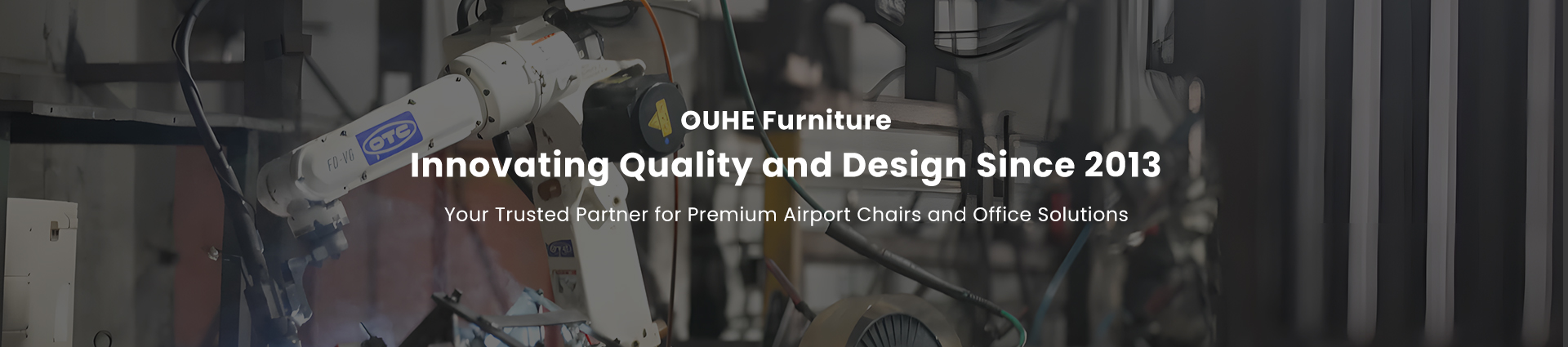
OUHE operates a large production base with multiple specialized facilities, supporting metal stamping, automated welding, spraying, packaging, and PU processing for stable output.Automated welding for consistency
Automated robot welding helps deliver repeatable joint quality, improving durability consistency across bulk orders and reducing variation between batches.Strong finishing and coating capacity
A structured spraying process supports stable surface quality for painted steel components, helping maintain a uniform look across large terminal installations.Product development strength for customization
OUHE supports engineering projects with internal product development and a large patent portfolio, which helps when airport projects require tailored layouts, materials, or seating configurations.
To explore available configurations and discuss your project requirements, view OUHE’s Waiting Chair options.
Conclusion
Airport chair material selection should match the real operating environment: passenger volume, cleaning frequency, humidity conditions, and the comfort level expected in each zone. PU seating structures deliver better sit comfort and a premium touch experience, especially when combined with aluminum support components and strong beam profiles. Stainless steel seating offers excellent sanitation and impact resistance for heavy-use areas. Painted steel solutions provide value and visual customization when coating quality and maintenance planning are handled correctly.
OUHE provides multiple material configurations in its Waiting Chair range, allowing buyers to balance durability, comfort, appearance, and budget for airport seating projects.