



How To Choose Hospital Waiting Chairs?
Hospital waiting areas are different from airports, malls, or office lobbies. Seating must support high turnover, frequent disinfection, mobility needs, and long dwell times without creating maintenance headaches. A good hospital Waiting Chair is not defined by one feature. It is the result of the right structure, surface, layout, and service plan that fits your department’s workflow.
OUHE provides commercial seating through the Waiting Chair range, with material options and production capacity designed for large public-space projects, including healthcare environments.
Start with the real-use scenario in each hospital area
Hospital seating decisions become easier when you treat each zone as a different project.
Outpatient registration and pharmacy waiting
This is the highest turnover zone. Chairs need fast cleaning surfaces, strong edge protection, and stable multi-seat beams that do not loosen under constant use.Emergency department waiting
This area sees higher stress, more movement, and more cleaning cycles. Prioritize impact resistance, anti-corrosion performance, and layouts that support visibility and access for wheelchairs and stretchers.Imaging, lab, and specialty clinics
Patients may wait longer, including elderly or post-procedure visitors. Comfort becomes more important, so seat contour, arm support, and stable posture support matter more.Family waiting near wards and ICU
Long dwell times increase discomfort risk. Seating should reduce pressure points, support upright posture, and include armrests that help standing up without sharp edges.
Choose materials based on cleaning, durability, and comfort
Hospitals disinfect more often than most public spaces. Material selection should match cleaning intensity and patient comfort needs.
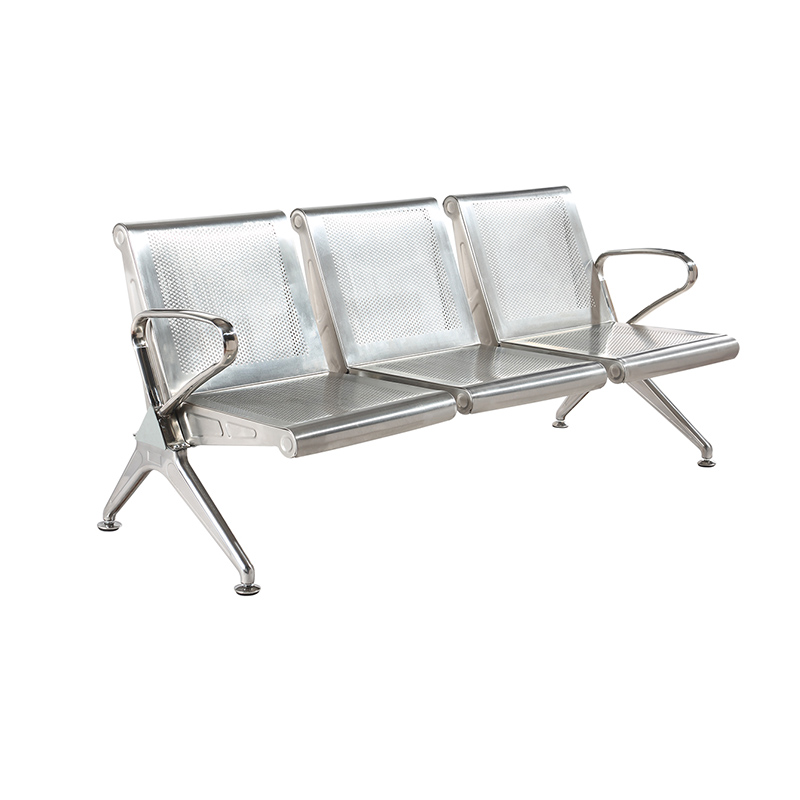
Stainless steel seating surfaces
Stainless steel is often chosen for healthcare because it supports fast wipe-down and does not absorb liquids. It also handles frequent disinfecting better than many coated surfaces.
Cleaning efficiency
Smooth metal surfaces are practical for high-frequency cleaning routines, especially where spills are common.Long-term appearance stability
Metal does not peel like some coatings. In high-contact zones, this can reduce visible wear and replacement cycles.Impact tolerance
Trolleys, wheelchairs, and bags collide with seating edges. Metal typically tolerates knocks better than many thin coated solutions.
Stainless steel seating is commonly used when the facility prioritizes sanitation speed and ruggedness.
PU seating surfaces with internal steel frame
PU seating can be a strong hospital choice when comfort is important, especially in long-wait zones. A steel frame inside the PU helps the seat maintain shape under repeated use.
Comfort for longer waiting periods
PU offers a softer sit than flat metal, which can help reduce discomfort during long waits.Practical wipe-down
PU surfaces can be cleaned quickly when properly specified for healthcare cleaning routines.Reduced cold-touch sensation
In air-conditioned hospitals, PU feels less cold than bare metal, which improves patient experience.
PU seating tends to fit areas like specialty clinics, family waiting zones, or departments with longer dwell time.
Painted steel seating surfaces
Painted steel can be used in large-scale installations when budget control and consistent look are priorities, but coating quality and cleaning practice matter.
Visual uniformity across large areas
A consistent finish helps when a hospital wants unified design across multiple departments.Project cost control
Painted steel can support large quantity rollouts while keeping procurement predictable.Maintenance planning
Hospitals should use non-abrasive cleaning tools to reduce micro-scratches. In very high-impact zones, stainless steel may reduce maintenance burden.
Check ergonomics that matter specifically in hospitals
Hospital Waiting Chairs must support a wider range of users than typical public seating, including elderly patients, pregnant visitors, and people with reduced mobility.
Armrest usefulness
Armrests are not only for comfort. They help patients stand up safely. Choose designs with stable arm support and edges that are smooth and easy to disinfect.Seat height and posture support
A seat that is too low increases difficulty standing. A seat that is too deep makes posture unstable for smaller users. Chair geometry should support upright posture without forcing slouching.Edge safety and clothing protection
Clothing snags and skin contact are common in healthcare settings. Rounded corners and clean seam design reduce injury risk and reduce complaint rates.Noise control
In quiet wards or clinics, squeaks and beam vibration become a user experience issue. Stable beam structure and consistent assembly reduce noise over time.
Select the right layout: single seat, tandem rows, and modular planning
Hospitals often redesign flow as departments expand. Seating should support both current layout and future adjustments.
Tandem beam rows for high-density areas
Multi-seat beam seating improves space utilization and keeps alignment consistent. It also simplifies cleaning under and around seats when spacing is well planned.Mixed seating zones for inclusivity
A practical approach is combining standard seats with open spaces for wheelchairs and mobility aids. This reduces congestion and supports accessibility without sacrificing capacity.Aisle and cleaning clearance
Hospitals need easy access for floor cleaning machines and quick spill response. Layout should provide clearance at chair legs and avoid trapping debris in tight corners.
Evaluate durability where failures usually occur
In public seating, most failures are not in the seat panel itself. They happen in joints, fasteners, and high-stress connection points.
Beam structure stability
A strong beam profile reduces flex. Less flex means less loosening of fasteners and fewer squeaks over time.Welding and connection consistency
Consistent welding improves stability and reduces the chance of cracked joints under repeated loading.Surface wear at edges and arm contact points
These are the first areas to show wear. Choosing durable finishes and easy-to-clean surfaces reduces visible aging.
Plan purchasing with a hospital-focused spec table
A hospital procurement team often needs a clear checklist that converts operational needs into spec language. This table helps structure the decision without relying on long lists.
| Hospital area | Primary priority | Recommended material direction | Layout direction | Key performance focus |
|---|---|---|---|---|
| Registration and pharmacy | Fast cleaning, high turnover | Stainless steel or durable PU | Tandem rows | Disinfection tolerance, impact resistance |
| Emergency waiting | Ruggedness, safety | Stainless steel | Tandem rows with clear aisles | Joint stability, corrosion resistance |
| Specialty clinics | Comfort and posture | PU with internal steel frame | Mixed zones | Long-wait comfort, easy wipe-down |
| Ward and ICU family waiting | Comfort, quietness | PU or high-quality coated solutions | Mixed zones | Noise reduction, supportive armrests |
| Imaging and lab waiting | Balanced comfort and cleaning | PU or stainless | Tandem rows | Easy cleaning, stable posture support |
Why OUHE is a practical supplier for hospital waiting chair projects
Hospitals often purchase in phases and need stable quality across batches. OUHE’s manufacturing foundation supports that kind of project delivery.
Large-scale production capability
OUHE operates a large production base with multiple specialized factories covering stamping, automated welding, spraying, packaging, PU processing, and Sofa production, supporting stable capacity for project timelines.Automated welding consistency
Automated robot welding improves repeatability, helping multi-batch orders maintain stable joint quality and reducing variation that can cause squeaks or loosening.Strong finishing and environmental process control
Spraying and finishing processes are important for coated components used in hospitals. Stable finishing reduces appearance drift across departments and improves long-term durability.Project customization support
Healthcare projects often require customized layouts, seat counts, or surface selections. OUHE supports project-oriented delivery through its product development capability and integrated production chain.
You can review available configurations and discuss a hospital project through OUHE’s Waiting Chair range.
Conclusion
Choosing a hospital waiting chair is a decision about real operations: cleaning frequency, patient mobility, waiting time, and the cost of maintenance over years. Stainless steel seating supports fast sanitation and impact tolerance for high-turnover zones. PU seating with internal steel frames improves comfort where people wait longer while still supporting efficient cleaning. Layout planning should protect accessibility and cleaning clearance, while durability depends heavily on beam stability and connection consistency.
OUHE provides project-ready seating solutions through its Waiting Chair collection, supporting hospitals that need dependable materials, consistent production quality, and scalable delivery.