


What Are Some Interesting Facts about Chairs?
Chairs are so familiar that their engineering is easy to overlook. Yet a chair combines human dimensions, structural mechanics, materials, manufacturing, cultural habits, and space planning in one everyday object.
Waiting Chairs make these relationships especially visible because one design must serve thousands of different users while remaining stable, cleanable, and organized.
1. A Chair Is a Load-Transfer Structure
A seated person’s weight does not stop at the seat surface. The load moves through the seat pan or cushion, brackets, beam or frame, legs, feet, and finally into the floor.
Small changes in joint position, beam section, leg spacing, or welding accuracy can change how stable the chair feels. That is why a public waiting chair must be evaluated as a complete assembly rather than as separate attractive parts.
2. Taller Is Not Always More Comfortable
Seat height affects how easily people sit and stand, but increasing it can leave shorter users without secure foot support. Lower seats may feel relaxed but require more effort to exit.
Seat depth creates a similar trade-off. Deep seating supports longer thighs while potentially pressing behind the knees of shorter users. Good chair design balances dimensions instead of maximizing one measurement.
3. Armrests Control More Than Arm Position
Armrests support the upper body and can assist with standing. In linked waiting chairs, they also divide personal space and discourage users from lying across several seats.
However, fixed armrests reduce flexibility for larger users and families with small children. This is why public-space layouts may combine armed and armless positions.
4. Linked Seating Changes Room Behavior
Individual chairs can drift into circulation paths as users move them. Beam-mounted waiting chairs keep rows aligned and make capacity easier to predict.
Linked seating also helps facility teams maintain planned aisles and sight lines. Its value is therefore partly behavioral and operational, not only structural.
5. The Best Airport Chair Is Not Necessarily the Best Clinic Chair
Airports accommodate luggage, long operating hours, and changing passenger volumes. Clinics may prioritize easy cleaning, supportive armrests, and seating for people with limited mobility.
Office reception areas place more emphasis on atmosphere and brand presentation. Calling all three products “waiting chairs” does not make their design requirements identical.
6. Furniture Packaging Begins During Product Design
Export chairs must fit cartons, containers, elevators, corridors, and site installation processes. Beam length, removable legs, detachable arms, and nesting or stacking decisions all affect logistics.
A design that saves a small amount of steel may increase carton volume or assembly time. Manufacturers therefore evaluate the entire route from production to final installation.
7. Robots Can Improve Repetition in Chair Frames
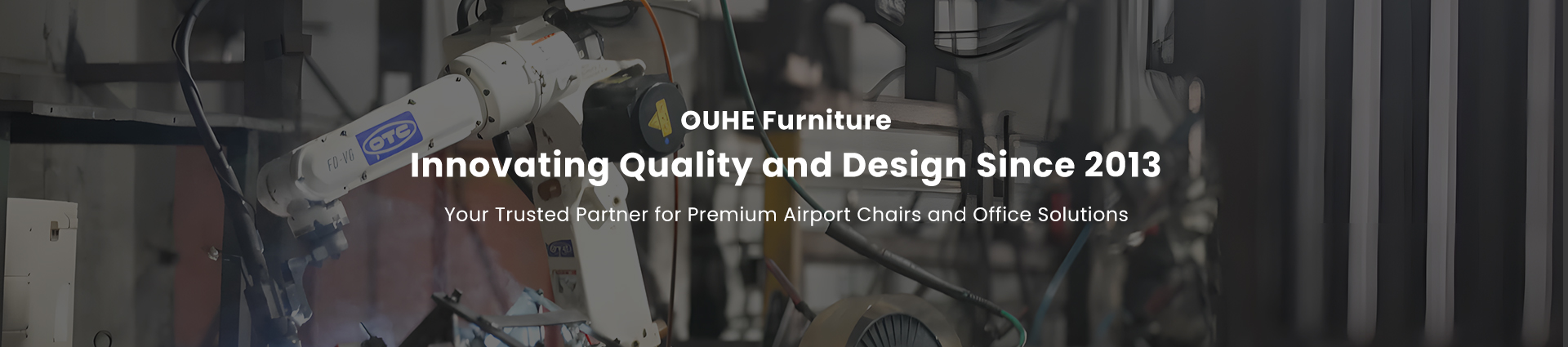
Our factory uses 40 Japanese OTC automatic robotic welding units for waiting-chair production. Automated welding supports consistent joint paths and repeatable frame geometry while allowing continuous production for large orders.
Four high-speed backrest punching machines operate at listed speeds of up to 320 punching cycles per minute. Together with integrated stamping, spraying, PU, carton, packing, and shipping facilities, this supports normal output exceeding 5,000 waiting-chair sets per day.
8. PU Seating Is Manufactured, Not Simply “Padded”
Polyurethane seating can be molded into controlled shapes rather than cut only from flat foam. Material color, hardness, size, and surface form can be adjusted through the formulation, mold, and production process.
Our factory operates PU foaming equipment and an internal mold-processing workshop. This enables us to manufacture and supply PU airport chairs, Hospital Waiting Chairs, armchairs, and coordinated public seating rather than purchasing generic seat pads for assembly.
9. Replacement Design Can Extend Furniture Life
A public chair may suffer localized damage while its main beam and legs remain usable. Replaceable seat units, armrests, feet, and fasteners prevent one damaged component from ending the service life of the complete row.
This principle matters to airports, hospitals, and stations because replacing an entire installation is more disruptive than maintaining standardized modules.
10. Color Has a Practical Function
Color can organize zones, support wayfinding, or distinguish service areas. It also affects how dirt, scratches, and wear appear during daily use.
For international projects, color approval should rely on physical samples under relevant lighting. Screens and catalog images cannot always represent a powder-coated or molded PU surface accurately.
How We Supply Waiting Chairs for Global Projects
Our factory produces airport chairs, hospital waiting seats, stainless steel benches, PU seating, office Sofas, and Classroom Desks And Chairs. Products are exported to more than 60 countries and regions, supported by a production base of over 50,000 square meters and seven specialized factories.
As an export-quality airport waiting chair supplier, we can coordinate one-to-five-seat configurations, materials, colors, beam designs, armrests, dimensions, spare parts, and packaging. From product design and mold development to welding, coating, PU production, cartons, and shipment, the main stages are managed within our production system.
The Chair Is a Small Piece of Architecture
Every chair directs posture, movement, personal space, and room capacity. In a waiting area, hundreds of these small decisions shape how people queue, rest, clean, move, and interact.
That is what makes chairs more interesting than they first appear: a successful design quietly coordinates the user, the building, the manufacturer, and years of daily operation.