


Airport Chair Manufacturers
Airport Chair manufacturers supply commercial seating for airports, railway stations, and other high-traffic public facilities. Buyers should evaluate factory production capabilities, metal fabrication, robotic welding, PU seat manufacturing, quality control, and OEM customization before selecting a long-term manufacturing partner.
What Do Professional Airport Chair Manufacturers Actually Produce?
Airport chair manufacturers specialize in connected seating systems developed for transportation facilities and other public waiting environments. These products are different from ordinary office chairs because they must accommodate frequent passenger turnover, repeated daily use, and practical maintenance requirements.
Common airport seating products include:
Metal airport chairs: Steel-based seating structures for public waiting areas.
Stainless steel airport chairs: Metal seating designed for environments where surface cleaning is an important consideration.
PU airport chairs: Cushioned seating combining PU surfaces with metal supporting structures.
Airport beam seating: Connected multi-seat systems with shared supporting beams.
airport lounge chairs: Individual or multi-seat products for premium passenger waiting spaces.
As a professional airport chair manufacturer, our production focuses on iron, stainless steel, and PU airport chair series. These products can be supplied in different configurations to meet the requirements of airport contractors, commercial furniture distributors, wholesalers, and international project buyers.
What Manufacturing Capabilities Should Buyers Evaluate?
A manufacturer's production capacity should be assessed through its actual equipment, production processes, and ability to maintain consistent product specifications.
For commercial airport seating projects, several manufacturing stages deserve particular attention.
1. Metal Stamping and Component Processing
Metal stamping determines the shape and dimensions of important structural components, including seat panels, legs, brackets, and supporting parts.
Consistent forming accuracy helps maintain component alignment during assembly. When a project requires hundreds or thousands of connected seats, dimensional differences between components can create unnecessary installation problems.
2. Robotic Welding and Frame Assembly
Welding quality directly affects the connection between the supporting beam, legs, armrests, and seat structure.
Robotic welding helps maintain repeatable welding positions and production consistency. However, the finished structure still requires inspection for alignment, weld appearance, and assembly accuracy.
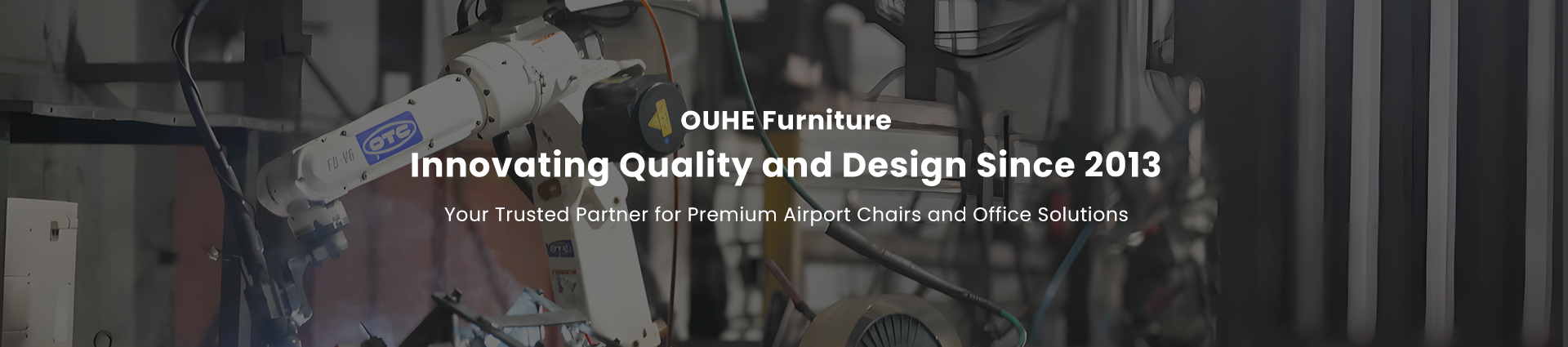
Our Waiting Chair manufacturing process uses Japan OTC automatic robotic arms for structural welding. This helps maintain more consistent production across repeated orders and large commercial seating projects.
3. PU Seat Manufacturing
PU airport chairs require more than a metal frame. The seat surface must also be produced with consistent dimensions, color, and material characteristics.
Our factory operates dedicated PU production facilities with specialized foaming equipment. This supports the production of PU seating components in different sizes, colors, and hardness options.
4. Surface Treatment
Metal components require suitable surface finishing according to the product specification.
Powder coating provides a protective and decorative surface for steel components. Buyers should evaluate coating uniformity, adhesion, scratch resistance, and compatibility with the intended operating environment.
5. Assembly and Final Inspection
The final inspection should cover seat alignment, armrest connections, beam stability, surface appearance, fasteners, and packaging protection.
For large airport furniture orders, maintaining consistent specifications between the approved sample and mass-produced units is particularly important.
How Can Buyers Identify a Factory With Real Manufacturing Capacity?
A supplier's website may describe it as a manufacturer, but buyers should look for evidence of actual production integration.
HESHAN OUHE FURNITURE CO., LTD. was established in 2013 and operates a production base exceeding 50,000 square meters, consisting of seven specialized factories.
These facilities cover:
Metal stamping.
Robotic welding.
Hardware spraying.
PU production.
Sofa manufacturing.
Carton production.
Packaging and shipment.
Our production facilities include 40 Japan OTC automatic robotic arms and four high-speed backrest punching machines. The normal daily production capacity for waiting chairs exceeds 5,000 sets.
These capabilities are particularly relevant to importers, engineering contractors, and commercial furniture wholesalers managing large-volume purchasing schedules.
More details about our production facilities, equipment, and company background are available on the About Us page.
Which Materials Are Suitable for Commercial Airport Seating?
Material selection affects structural performance, passenger comfort, maintenance, and product appearance.
| Material | Main Function | Purchasing Consideration |
|---|---|---|
| Carbon steel | Supporting frames and beams | Thickness, forming and welding |
| Stainless steel | Seat panels and structural components | Grade and surface finish |
| Aluminum | Armrests and supporting legs | Component thickness and connection |
| PU | Cushioned seat and backrest surfaces | Hardness, surface quality and cleaning compatibility |
| Powder coating | Protective metal finish | Adhesion, appearance and chemical compatibility |
A combination of different materials can provide a more practical seating structure than using one material throughout the entire product.
For example, our P2108 Airport Seating Chair combines a PU-covered steel inner frame, metal armrests and legs, and a metal triangular beam. It is available in one-to-five-seat configurations.
This structure provides a cushioned passenger contact surface while maintaining a metal supporting system.
Buyers can review the actual specifications on our Airport Seating Chair product page.
How Important Is OEM and ODM Customization for Airport Chair Projects?
Standard airport chairs may not always match the dimensions, appearance, or seating capacity required by a particular project.
For international B2B buyers, OEM and ODM cooperation can provide more flexibility when developing a commercial seating solution.
Depending on the selected product structure, customization discussions may include:
One-to-five-seat configurations.
PU seat and backrest colors.
Metal frame finishes.
Armrest and leg materials.
Supporting beam structures.
Product dimensions and installation requirements.
Packaging and branding details.
Our factory integrates metal processing, PU production, spraying, and packaging, allowing different manufacturing stages to be coordinated during product development.
For customized projects, buyers should provide reference drawings, expected quantities, preferred materials, and installation dimensions before sample approval.
How Should Airport Chair Manufacturers Be Compared?
Choosing a manufacturer based only on the quotation can create problems later, particularly when the project involves repeated purchasing or multiple installation locations.
A more practical assessment should cover:
Manufacturing experience: Whether the supplier has established experience producing airport and public waiting chairs.
Production integration: Whether important manufacturing processes are handled within its own production system.
Material control: Whether steel, PU, and surface finishing specifications are clearly documented.
Product consistency: Whether repeated production batches can maintain the approved specifications.
Customization capability: Whether the factory can coordinate different seating configurations and materials.
Export support: Whether packaging, documentation, and delivery arrangements meet the buyer's requirements.
A manufacturer with integrated production facilities can help reduce communication gaps between metal processing, welding, surface treatment, and final assembly.
What Should Buyers Prepare Before Requesting an Airport Seating Quotation?
A detailed project brief makes it easier for an airport chair manufacturer to recommend an appropriate product.
Buyers should prepare the following information:
Project location and application environment.
Required number of seats.
Preferred airport chair models.
Material and color requirements.
Available installation dimensions.
Customization or branding requirements.
Estimated purchasing quantity.
Packaging and delivery expectations.
Providing these details early helps the manufacturing team assess product suitability and prepare a more accurate quotation.
Discuss Your Airport Seating Manufacturing Requirements
Selecting airport chair manufacturers is a decision that affects product consistency, project coordination, and long-term supply arrangements.
Our team works with airport contractors, furniture importers, distributors, and wholesale buyers to discuss commercial seating specifications, product configurations, and manufacturing requirements.
Send your project drawings, required seat quantities, preferred materials, and customization details through our Airport Chair Inquiry Page to discuss a suitable manufacturing and supply solution.